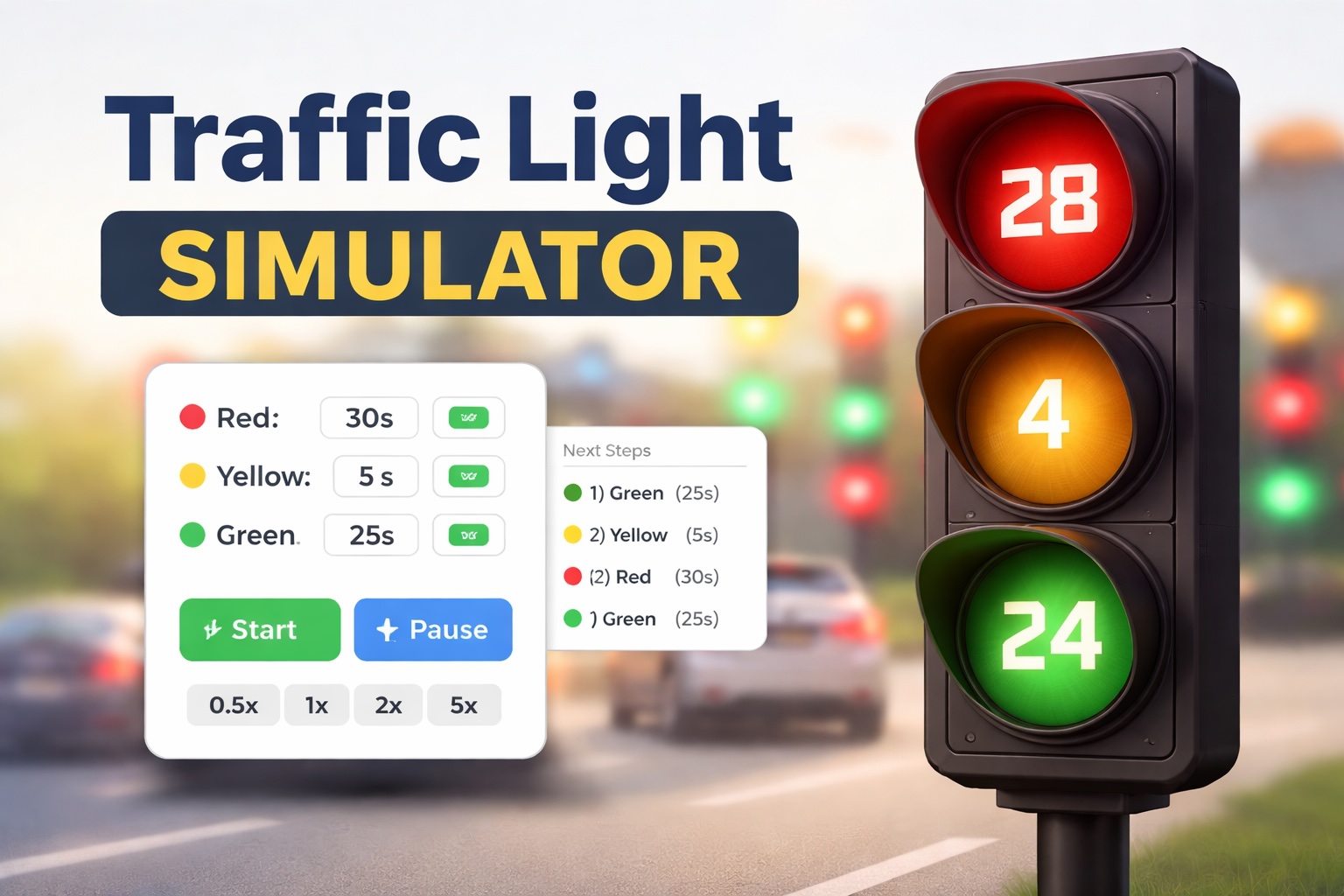
A traffic light simulator is a simple yet powerful tool that visually demonstrates how signal timing works in real-world intersections. By allowing users to adjust red, yellow, and green durations and instantly see the results, this simulator becomes useful across education, planning, testing, and training scenarios.
🚦 Traffic Light Timer Editor
Configure and simulate traffic light sequences
⏱️ Durations
▶️ Playback
📋 Presets
Below are the most common and valuable use cases for a simple traffic light simulator.
1. Traffic Engineering and Signal Timing Practice
This simulator is ideal for understanding the fundamentals of traffic signal timing.
Users can:
- Experiment with different red, yellow, and green durations
- Observe how timing changes affect traffic flow
- Visualize real-world intersection logic without physical infrastructure
It is especially useful for:
- Traffic engineering students
- Urban planning trainees
- Entry-level transportation professionals
The ability to preview upcoming light sequences helps users anticipate phase transitions and refine timing strategies efficiently.
2. Education and Classroom Demonstrations
Teachers and instructors can use the simulator as a visual teaching aid.
Common educational uses include:
- Explaining traffic signal phases to students
- Demonstrating why yellow timing matters
- Teaching cause-and-effect relationships in timed systems
Because the tool runs entirely in a web browser and requires no installation, it works well in classrooms, labs, and remote learning environments.
3. Driving Theory and Road Safety Training
Understanding traffic signals is essential for new drivers and pedestrians.
This simulator can support:
- Driver’s education courses
- Road safety awareness programs
- Pedestrian signal understanding
Learners can visually see:
- How long lights typically stay active
- Why stopping decisions must be made early
- How predictable signal patterns improve safety
4. Software Development and UI Prototyping
Developers often need simple, visual timing logic for applications.
This tool can be used to:
- Prototype countdown timers
- Test state-based animations
- Study interval-based JavaScript logic
- Validate timing UX before implementing complex systems
Because the simulator is built with plain HTML, CSS, and JavaScript, it serves as a reference for lightweight, framework-free implementations.
5. Simulation and Game Logic Testing
Traffic light logic is frequently used in simulations and games.
Possible applications include:
- City-building game mechanics
- AI traffic behavior testing
- Educational simulation projects
- Timing logic validation before engine integration
The “next sequence” preview makes it easier to verify predictable state transitions.
6. Public Planning and Community Demonstrations
Urban planners or community groups can use the simulator to explain traffic changes to the public.
It helps demonstrate:
- Why certain intersections feel slow or fast
- How timing adjustments impact waiting time
- What happens when phases are shortened or extended
This transparency can improve understanding and reduce confusion during traffic system updates.
7. Accessibility and Research Testing
Researchers can use the simulator to explore:
- Reaction time requirements
- Countdown visibility effectiveness
- User behavior during phase transitions
The tool allows rapid iteration without expensive equipment or real-world testing risks.
8. Offline and Lightweight Use
Because the simulator runs as a single HTML file:
- It works offline
- It loads instantly
- It can be embedded in websites or learning platforms
This makes it suitable for low-bandwidth environments and quick demonstrations.
Why a Simple Traffic Light Simulator Matters
Even without advanced intersection features, a basic traffic light simulator provides clarity, predictability, and insight into how timed systems operate. Its simplicity allows users to focus on timing logic rather than complexity, making it an effective educational and testing tool.
Whether used for learning, planning, development, or demonstration, a traffic light simulator offers a practical way to understand one of the most common control systems used in daily life.



Leave a Reply